Abstract: In this paper, we present a snapshot of Internet worm activity from September to November 2001, bearing witness to the rise of Nimda (and Nimda.E), the death of CodeRedII (and CodeRed.d), and a resurrection of the original CodeRed. We determine the demographics of the various worm-infected populations, and make predictions as to their future growth, attrition, and impact. These findings represent the early results of our ongoing research in ``blackhole monitoring'' - the instrumentation and analysis of an unused class A network, or 1/256 of the entire Internet address space, for evidence of global Internet attack activity.
In the breakdown of these infection attempts by country, and top-level domain in Table 2, .net and Korean hosts figure prominently, comprising more than half of all worm-infected hosts. This may be due to the high concentration of cable modem and DSL providers in .net, and the singular broadband Internet phenomenon in Korea. According to a March 2001 Nielsen/Netratings study of 21 countries worldwide, Korean users are the world's most active Internet surfers, leading the world in the number of visits to the World Wide Web, the number of unique sites visited, the number of pages downloaded, and time spent on the Internet per session and per month [NN01]. In August 2001, Nielsen/Netratings reported the near-saturation of the Korean broadband market, with 15.8 million broadband users, representing 95% of all Korean web surfers [Ya01].
Worm type hits % of total CodeRed 1592 10 CodeRedII 1884 12 CodeRed.d 2655 16 Nimda + Nimda.E 9928 62
CodeRed % CodeRedII % CodeRed.d % Nimda % .net 49 .net 46 .net 47 .net 53 Korea 16 Korea 27 Korea 32 Korea 21 .com 11 .com 13 .com 8 .com 11 .edu 6 China 4 China 4 China 5 Germany 2 Germany 3 Germany 3 .edu 2 Italy 2 .edu 3 .edu 2 Germany 2 Brazil 2 France 2 France 2 Taiwan 2 Spain 2 Italy 2 Italy 2 USA 2 Netherlands 2 Taiwan 1 Canada 2 China 2 France 2 Denmark 2
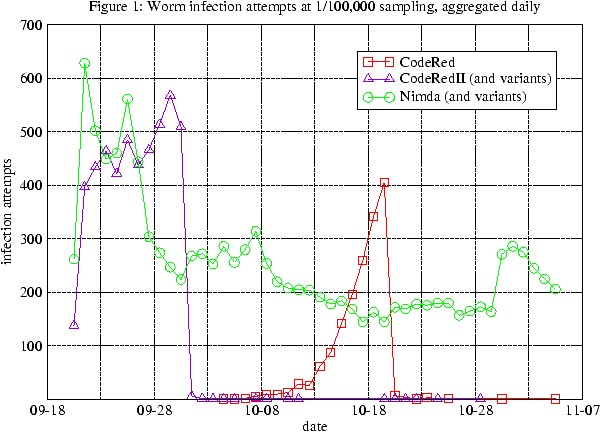
The graph of CodeRed, CodeRedII, and Nimda infection attempts in Figure 1 illustrates the pecularities of each worm's propagation and their interactions. For example, Nimda's initial propagation begins with a sudden, dramatic burst, and then closely follows CodeRedII's lead - most likely due to contention for the same hosts (one of Nimda's infection vectors includes the root.exe backdoor left on IIS servers by CodeRedII). Similarly, the time-coded limits to CodeRed and CodeRedII's propagation stages, originally identified by eEye security researchers in their disassembly of these worms, are borne out in the graph with CodeRedII's sudden demise on October 1st, and CodeRed's short-lived resurrection from October 1st to 19th. The appearance of the new Nimda.E variant on November 1st also results in a minor resurgence, before returning to current levels.
This document was translated from LATEX by HEVEA.